
Published by the Veer Care Editorial Team
Important Community & Patient Notice Based on a Real Case: The following article is developed directly from a real visual medical consultation between a subscriber and an actual licensed doctor on the Veer App. Not all medical consultations are adapted into clinical articles; we carefully select conversations addressing common, high-utility health questions to benefit our broader community.
Privacy & Anonymity Commitment: To protect patient confidentiality, all Personally Identifiable Information (PII) is strictly removed or sanitized before publishing. No names, exact locations, specific background histories, or identifying records are ever shared. For more details on our zero-sharing data guidelines, please read the Veer Care Privacy Policy.
The Query: “I’ve vomited 10+ times, have loose stools, and haven’t passed urine in 20 hours. What should I do?”
During an urgent visual triage call on the Veer App, a 35-year-old female subscriber presented with critical gastrointestinal distress. She had experienced more than ten explosive episodes of vomiting and loose stools. She was suffering from a profound, repulsive feeling toward all food and liquids, making it impossible to keep anything down. Most alarmingly, she reported zero urine output for the past 20 hours.
She asked:
Is going 20 hours without passing urine dangerous during a stomach bug?
How can I rehydrate when even a single sip of water makes me vomit instantly?
Given that I am physically too weak to travel to a hospital right now, how can virtual triage safely stabilize me?
Here is the structured clinical guidance provided by the consulting Veer medical specialist.
1. The Clinical Red Flag: Why Zero Urine Output Matters
In any case of acute gastroenteritis (stomach flu), the frequency of vomiting is concerning, but the volume of fluid lost dictates the clinical risk. Going 20 hours without passing urine is a clear physiological signal that the body has entered a state of severe dehydration.
When fluid volume drops drastically, the kidneys proactively halt urine production to preserve whatever water remains in the bloodstream to protect vital organs like the heart and brain. If left unmanaged, this prolonged lack of perfusion (blood flow) can lead to acute kidney injury.
The Autoimmune Complexity: Immunomodulators & Lupus
The patient’s medical history added another layer of complexity: she was currently taking immunomodulators for suspected, unconfirmed Lupus (an autoimmune condition).
Immunomodulators alter the body’s immune defense mechanisms. This meant her body was significantly more vulnerable to opportunistic viral or bacterial infections. Furthermore, severe dehydration combined with these specific medications can place an extra, compound strain on renal (kidney) function. Stabilizing her fluid levels immediately was of paramount importance.
2. Navigating the “Vomiting Cycle” with Sublingual Medication
When a patient has a “repulsive feeling” toward liquids and vomits continuously, standard oral pills are useless. They are typically thrown up before they can dissolve in the stomach, leaving the patient unmedicated and increasingly depleted.
Because the patient was physically too weak to travel to an emergency room for an intravenous (IV) drip, the Veer doctor broke the vomiting cycle using sublingual (under-the-tongue) medication.
[Severe Vomiting] ──> Standard Oral Pills Rejected ──> Continued Dehydration
(Pivoted to Sublingual) ▼ [Sublingual Anti-Emetic] ──> Dissolves Under Tongue ──> Enters Bloodstream Instantly ──> Vomiting Stops
The doctor prescribed a fast-acting sublingual anti-emetic (anti-vomiting tablet). This specialized tablet dissolves within seconds under the tongue. The medication bypasses the digestive tract entirely, absorbing directly into the bloodstream through the rich network of blood vessels in the mouth. Within minutes, the brain’s vomiting triggers are calmed, creating a crucial clinical window of opportunity to begin rehydration.
3. The Micro-Sipping Rehydration Protocol
Once the sublingual medication successfully stopped the active vomiting, the next challenge was reintroducing fluids without triggering a secondary wave of nausea. The doctor emphasized that standard gulping must be strictly avoided.
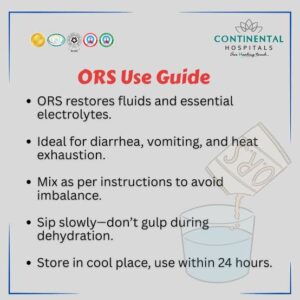
As outlined in the guide above, the patient was initiated on a highly controlled Micro-Sipping Protocol:
The Solution: An Oral Rehydration Solution (ORS) was prepared exactly according to package directions to ensure the perfect ratio of water, salts, and glucose.
The Pace: The patient was instructed to take just one teaspoon or tiny sip every 3 to 5 minutes.
Gradual Scaling: Gulping water stretches the highly sensitive, inflamed stomach lining, triggering a reflex muscle contraction that causes vomiting. By introducing tiny amounts slowly, the stomach absorbs the fluid gradually, allowing the patient to slowly increase the volume over the next few hours.
4. Guardrails: The Home “Skin Pinch” Turgor Test
To ensure the patient remained within safe boundaries while recovering at home, the Veer doctor taught her caregiver how to perform a clinical assessment called the Skin Turgor Test to actively monitor fluid levels in the tissue.

How to Perform the Test:
Gently pinch the skin on the back of the hand or abdomen between two fingers to form a small tent shape.
Hold for two seconds and release.
The Evaluation: In a well-hydrated individual, the skin snaps back to its flat, normal position instantly. If the skin remains elevated (tented) or sinks back sluggishly, it indicates that the tissues have lost their elasticity due to critical fluid depletion.
When to Transition to the Hospital Immediately
The doctor provided the patient and her family with definitive boundaries. They were instructed to call an ambulance or arrange immediate hospital transport if any of these Danger Signs manifested:
The skin pinch test remains “tented” for more than 2 seconds.
Urine output fails to return within 4 to 6 hours after starting the micro-sipping protocol.
The patient experiences sudden confusion, extreme lethargy, or slurred speech (signs of severe electrolyte imbalances affecting the nervous system).
Facing a Medical Crisis at Home?
Severe vomiting and dehydration can drain your strength so quickly that traveling to a clinic feels impossible. If you or a family member are trapped in a cycle of illness and cannot leave the house, let Veer bring the doctor to you. Open your Veer App and tap “Urgent Care” to connect with a doctor who can visually assess physical danger signs, prescribe fast-acting sublingual remedies, and safely navigate your recovery step-by-step.