
Published by the Veer Care Editorial Team
Important Community & Patient Notice Based on a Real Case: The following article is developed directly from a real visual medical consultation between a subscriber and an actual licensed doctor on the Veer App. Not all medical consultations are adapted into clinical articles; we carefully select conversations addressing common, high-utility health questions to benefit our broader community.
Privacy & Anonymity Commitment: To protect patient confidentiality, all Personally Identifiable Information (PII) is strictly removed or sanitized before publishing. No names, exact locations, specific background histories, or identifying records are ever shared. For more details on our zero-sharing data guidelines, please read the Veer Care Privacy Policy.
The Query: “I’m in my first trimester and having abdominal and vaginal pain. Am I having a miscarriage?”
During a recent urgent visual triage call on the Veer App, a subscriber in her first trimester reached out in a state of high anxiety. She was experiencing persistent discomfort in her lower abdomen that seemed to radiate toward the vaginal region. Given how early she was in her pregnancy, her immediate and deeply understandable fear was the possibility of an impending miscarriage.
She asked:
- Is this lower abdominal and vaginal pain a definitive sign of a miscarriage?
- What else could be causing this type of pain so early on?
- How can I safely manage the pain right now, and what should I tell my OB-GYN?
Here is the structured clinical guidance provided by the consulting Veer medical specialist.
1. De-escalating the Fear: Normal Pregnancy Cramping vs. Red Flags
The first step in our clinical triage was to assess the exact nature of the pain. First-trimester cramping is incredibly common and often completely benign. As the uterus begins to expand, implantation occurs, and hormonal shifts alter digestion, the body naturally experiences stretching sensations that feel like mild to moderate menstrual cramps.
However, to rule out a miscarriage or an ectopic pregnancy (where the embryo implants outside the uterus), doctors look for specific “red flag” symptoms.
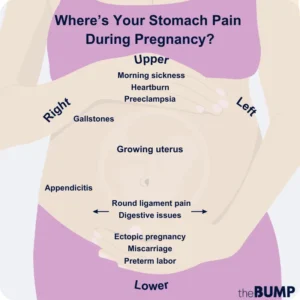
As shown in the medical reference diagram above, lower abdominal pain can stem from normal changes like a growing uterus or digestive issues, but it is also the zone for miscarriage risks. Because the subscriber did not have active vaginal bleeding, fluid discharge, or severe, one-sided sharp pain, the consulting doctor was able to reassure her that an immediate miscarriage event was highly unlikely. The primary diagnosis pointed toward severe localized muscle cramping and dehydration.
2. The Differential Diagnosis: Could It Be Kidney Stones?
When a pregnant patient presents with lower abdominal pain that radiates downward toward the groin or vaginal region, a seasoned clinician looks beyond the uterus. This path of radiating discomfort is a classic presentation for a differential diagnosis (exploring alternative medical conditions that mimic the main symptom): Nephrolithiasis, or kidney stones.
During pregnancy, a woman’s urinary system undergoes massive structural changes. Elevated progesterone relaxes the ureters (the tubes connecting the kidneys to the bladder), which slows down urine flow. If a stone forms and begins to move down the urinary tract, it causes sharp, episodic spasms.
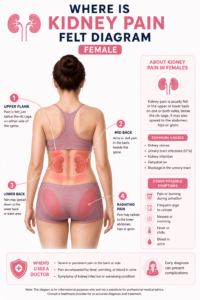
As illustrated in the diagram, while kidney issues originate in the flank or back, the pain pathways frequently radiate downward into the lower abdomen and groin area. This perfectly explains why the patient felt discomfort near the vaginal region, even though the issue may have been rooted in her urinary tract.
Dietary Triggers: The Role of Oxalates
The doctor investigated the patient’s recent dietary habits. Consuming a high volume of outside food prepared with ingredients rich in oxalates can rapidly accelerate stone formation, especially if water intake is low. Common high-oxalate foods include:
- Leafy Greens: Spinach (palak)
- Vegetables: Tomatoes
- Snacks: Nuts and chocolates
When excess oxalates bind with calcium in the kidneys, they form calcium oxalate crystals—the most common building block of kidney stones.
3. Immediate, Safe Management Protocol
Because the patient was experiencing standard muscle cramping potentially aggravated by mild urinary tract irritation, the Veer specialist outlined a safe, pregnancy-approved management plan.
Critical Safety Warning: Never take over-the-counter anti-inflammatory medications like Ibuprofen, Aspirin, or Aleve during pregnancy unless explicitly directed by your physician. These belong to a class of drugs called NSAIDs, which can cause severe complications, including reducing amniotic fluid levels or affecting the baby’s cardiac development.
Instead, the doctor advised a strict, conservative two-pronged strategy:
- Aggressive Oral Hydration: The patient was directed to immediately begin sipping an Oral Rehydration Solution (ORS) alongside electrolyte fluids. Proper hydration dilutes urine, flushes out accumulating crystal sediments before they form large stones, and directly stops uterine and abdominal muscle spasms.
- Safe Symptomatic Pain Relief: For temporary pain management, the doctor approved standard Paracetamol (Acetaminophen). Paracetamol remains the first-line, medically verified pain reliever deemed safe for fetal development across all trimesters.
4. Next Steps for Clinical Follow-Up
While the immediate threat was managed, a definitive look inside is necessary to confirm the exact health of the kidneys and bladder. The consulting doctor provided the patient with a clear action plan for her next routine check-up:
- Inform the Radiologist: At her upcoming scheduled pregnancy ultrasound scan, she must explicitly request the radiologist to scan her kidneys and upper urinary tract to check for any hidden stones or swelling (hydronephrosis).
- Brief the OB-GYN / Gynecologist: She must flag this exact episode of radiating pain to her primary obstetric team so they can run a quick, routine urine routine and microscopy test to look for microscopic traces of blood or crystals.
How to Consult on Your Specific Symptoms
Are you experiencing unexpected aches, cramps, or sharp pains during your pregnancy? Do not sit at home worrying or guessing. If you are a Veer subscriber, you can open your app and tap the “Urgent Care” button right now. Our on-duty medical professionals are available 24/7 via visual triage calls to evaluate your symptoms, ease your anxiety, and give you clear, actionable steps to keep both you and your baby perfectly safe.
If you are an expecting mother and need urgent medical clarity—at any hour of the day or night—open the Veer App and tap “Urgent Care“ to connect with a doctor instantly.